
◫ The concept
Record the fingerprint now, so you can compare the file later.
Anyone can run this check without us — the record is public, and verifying it needs nothing from Quantum Notary.
How file verification works · 5:30
Today
You record the file
Your file
Hashed locally in browser. Not uploaded.
Its fingerprint
a3f9c21d…2a6df85b
Fingerprint written to a dated Base block
Public, readable by anyone, and not ours to edit or withdraw.
Later
You need to prove it
The file in question
Anyone can hash the file again using the same algorithm, SHA-256.
Same fingerprint
a3f9c21d…2a6df85b
Strong evidence this copy matches the bytes recorded earlier.
Different fingerprint
f41b09ce…77d2e8a0
The file has been edited, tampered with, or is not the same file as the original.
One edit anywhere changes the fingerprint, which is what makes a change visible. Recording the fingerprint on Base provides a dated reference for these exact bytes. A later match is strong evidence of the same bytes, but does not establish what happened in between.
Learn More with Interactive Demos →See your file’s hash
Drop a file to hash
computed in your browser · we only ever see the digest
Digest · SHA-256
—
Visual fingerprint
Nothing hashed yet.
▤ Your notarizations
Every record you've notarized, in one place.
- Search by filename or digest
- Track anchoring status
- View transaction and block references
- Download your proof
◆ Once made, proofs are independent of us
If we stop existing, your record does not.
We cannot edit it.
The record is a transaction in Base’s public history. We do not run that ledger and cannot overwrite an included transaction.
We cannot delete it.
Not on request, not by mistake, not under a subpoena. No mechanism exists by which we could, and there is none we could build.
We cannot take it back.
Not if you cancel, not if you stop paying, not if you fall out with us entirely. It was never ours to withdraw.
We cannot stand in the way of a check.
Reading it back needs a Base explorer or an RPC provider, and neither of those is us. You do not need our page or our permission.
That is not a policy we chose. It is how the mechanism works. Your file's fingerprint went into Base's public transaction history, and nobody needs to come through us to read it there. Keep the exact original file. Where to look is on the receipt: block number, transaction hash, and which slot in that transaction holds your fingerprint. Any Base explorer will take it from there, and our database never comes into it.
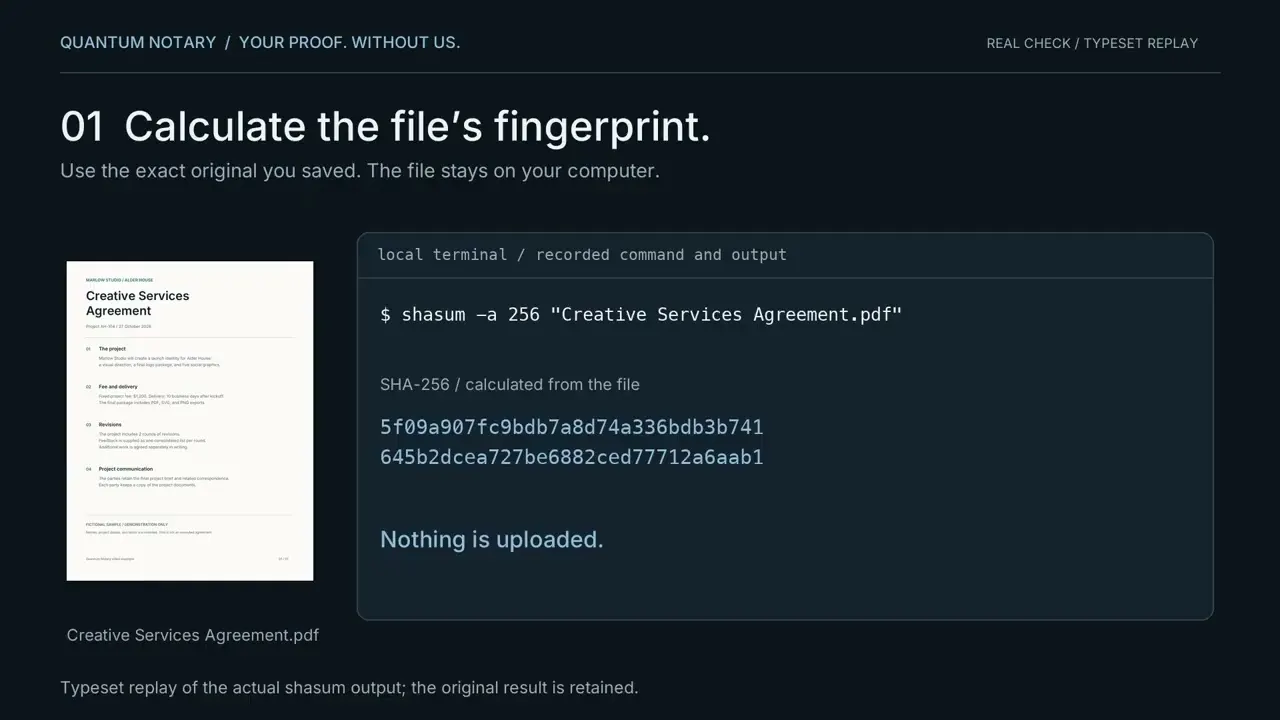
▸ How it works
Drag it in. Click once.
We deal with the chain.
No wallet, no gas, no keys, nothing to install. The browser file flow computes a fingerprint on your machine, keeps the file body local, and sends the digest plus selected metadata. It returns the references a checker needs.
Drag the file in
Or click to browse. The bytes are read on your machine and the file itself does not leave it.
Click Notarize
Choose your file in Notarize and spend one credit. We pay the gas and sign the transaction.
The proof comes back
Transaction and block references, an explorer link, and a receipt to keep beside the file.
Watch the full walkthrough · 6:16
Illustrative agreement · Recorded on Base mainnet
◈ Why anchor on a public chain
A chain record outside our database.
Hash-only privacy
The browser file flow hashes exact file bytes locally and sends the digest plus selected metadata. A public digest is not encryption or automatic anonymization.
Public-chain anchored
New records use a zero-value Base transaction whose calldata is a 32-byte-aligned array of raw digests, holding your own 32 digest bytes at a named slot. The service marks a record finalized after observing a successful Base L2 receipt; it does not monitor Ethereum L1 settlement.
Verifiable without us
A receipt includes Base transaction and block references. Direct verification can avoid our application, but it still depends on retained input, the processing rule, and suitable historical Base access.
Before it becomes a question.
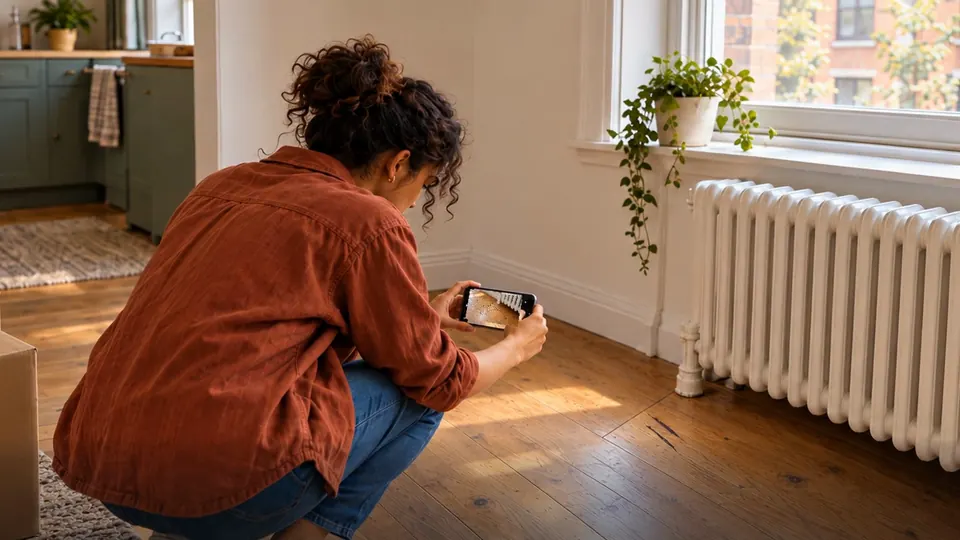
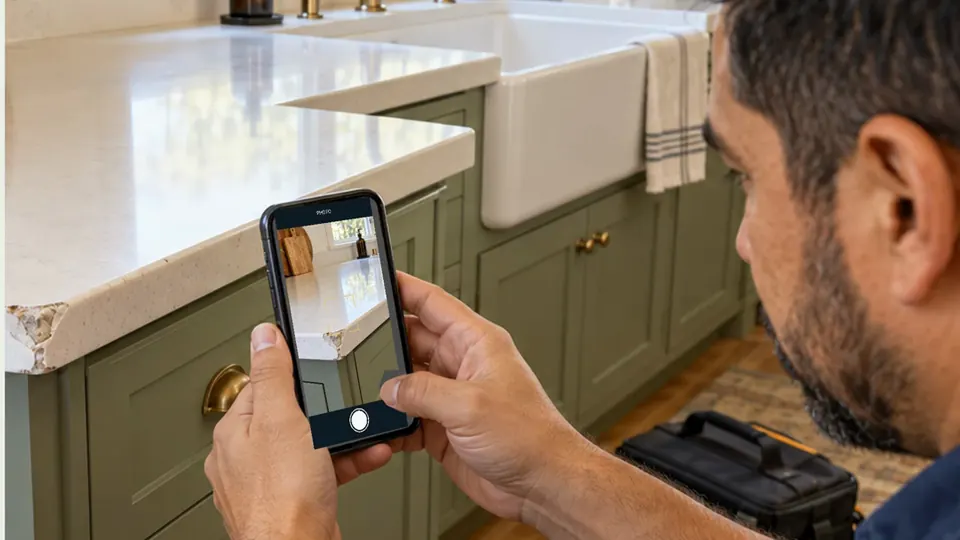
Illustrative scenarios

▸ Questions people ask
FAQ
How do I prove a file existed on a date?
Record your file’s digital fingerprint on the Base blockchain, then keep the unchanged file and your receipt. Anyone with both can check the match later. A match shows the file existed no later than that transaction.
Do I need an account?
No account is needed to check a file or download the independent verifier. Create an account and verify your email to notarize files and manage your records.
How much does it cost?
Each notarization uses one credit. Buy credits in one-time packs; see Pricing for current offers. Checking a file is free, with no account or card required. View pricing →
Will a court accept this?
That depends on the court and the case. The record can help show that a file existed by a date, but does not guarantee acceptance. Ask your lawyer what supporting evidence you need.
Is this the same as a notary public?
No. We do not perform legal notarial acts, verify identity or witness signatures. We record a file’s digital fingerprint on a public blockchain.
Does this prove I own the file, or that I made it?
No. A file’s fingerprint does not identify its creator or owner. The link between your Quantum Notary account and the record can provide additional supporting evidence, but it does not establish authorship or ownership on its own. Keep drafts, contracts, delivery emails and other correspondence alongside your file and receipt to support those claims.
Does it show when the photo was taken?
No. It shows the photo file existed no later than the Base transaction that recorded its fingerprint. It does not verify the capture time or the photo’s contents.
Do you see my file?
No. Your browser computes a fingerprint locally; the file itself is never uploaded. Notarization sends the fingerprint, filename, size and available type as off-chain record metadata. A fingerprint is not encryption.
What actually goes on the blockchain?
Your file’s SHA-256 fingerprint (32 bytes), at the position named in your receipt. Your file, filename and account details stay off-chain. Several fingerprints may share a transaction, which reveals that those records were submitted around the same time.
What if I lose the original file, or re-save it?
You need an unchanged copy to verify a match. Re-saving, exporting or compressing a file can change its fingerprint, even if it looks identical. We cannot recover a lost file from its fingerprint.
What happens if Quantum Notary disappears?
Your fingerprint remains in Base’s public history, which we cannot edit or delete. Keep the unchanged file and download your receipt. You can recompute the fingerprint and check it using a Base blockchain explorer, as long as that history remains accessible. Watch the 3-minute demonstration →
Is this a qualified electronic timestamp under eIDAS?
No. We do not issue qualified electronic timestamps. If you need one under EU eIDAS rules, use a qualified timestamping provider on an EU trusted list.